Workplace Violence Prevention and Active Assailant Response
- Covers warning signs and the four kinds of workplace violence
- De-escalation and how to get away from danger
- Certificate per employee for your training file
By profession
Workplace Safety (OSHA)
Most California employers now have to train every employee on workplace violence, every year, and keep proof. Here is what Labor Code 6401.9 asks for, who is exempt, and how to put a training round together this month.
Training is required when the plan is first established and every year after that, plus extra training when hazards or the plan change (Labor Code 6401.9(e)).
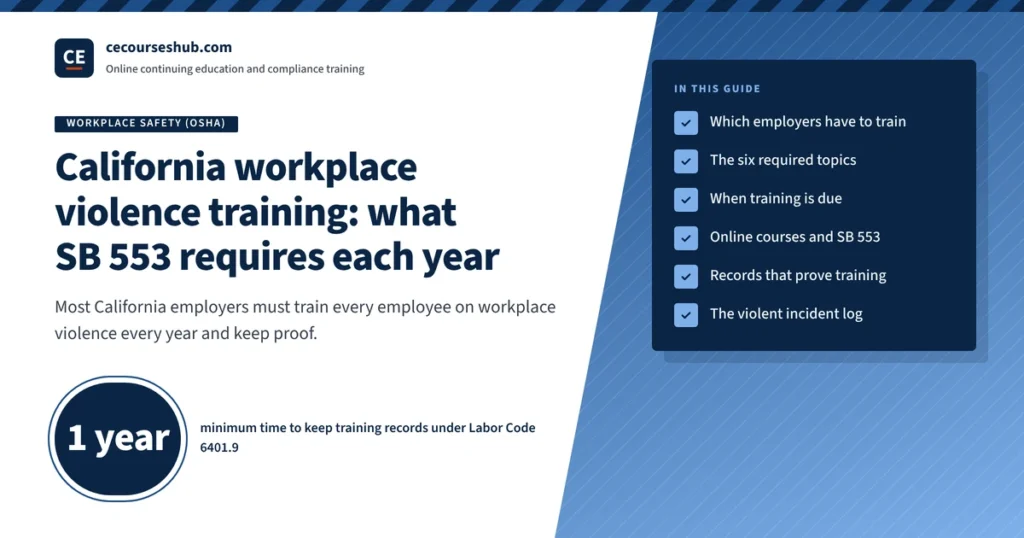
California Labor Code section 6401.9, added by SB 553, requires most employers to keep a written workplace violence prevention plan and to train employees on it, first when the plan is established and then annually. The training must cover six topics set out in subdivision (e)(2), including an opportunity for interactive questions and answers with someone who knows your plan. Training records must be kept for at least one year. The requirements have been enforceable since July 1, 2024.
Need this year's training done quickly?The Workplace Violence Prevention and Active Assailant Response course gives each employee the core knowledge in 2 contact hours online, with an instant certificate after they finish. Add your own plan session and you have a full training round.
Start the workplace violence courseIf you run HR, operations or a small business in California, SB 553 probably landed on your desk as one more compliance item with no clear owner. The plan part gets attention because it is a document. The training part is easier to miss, and it repeats every year. When a Cal/OSHA inspector or an employee asks for proof, what matters is whether you can show who was trained, when, on what, and by whom.
This guide covers the training duty only: who it applies to, the six required topics, timing, how an online course fits, and the records to keep. It also covers the Cal/OSHA standard that is still being drafted. If you are also planning other California training this year, the Employer Training Planner lets you map each requirement by role and deadline in one place.
The starting point is broad. Labor Code 6401.9(b)(1) says the section applies to all employers, employees, places of employment and employer-provided housing in California. Coverage is not limited to high-risk industries. A dental lab, a warehouse, a nonprofit office and a coffee shop are all covered unless an exception fits. Work through these questions for each location.
Is the location a health care facility, service category or operation covered by the Title 8 section 3342 health care violence standard, or does the employer comply with section 3342?
Follow section 3342 insteadIs the employer a law enforcement agency that meets the conditions in the statute, or a facility run by the Department of Corrections and Rehabilitation?
Listed exception: check the conditionsIs the employee teleworking from a place of their choice that the employer does not control?
That telework location is excludedAre fewer than 10 employees working there at any given time, is it closed to the public, and does it comply with the Title 8 section 3203 injury and illness prevention program?
Excluded only if all three are trueNone of the above fits.
Covered: plan, log, training, recordsThe small-site exception is narrow. A shop with eight staff that serves walk-in customers is not exempt, because it is accessible to the public. A back office with eight staff and no public access is only exempt if its general injury and illness prevention program under Title 8 section 3203 is in compliance. Cal/OSHA's FAQ also notes that a building or location that must comply with section 3342 does not also have to comply with 6401.9, so health care employers should follow their own standard.
Subdivision (e)(2) lists six required elements. Some are general knowledge that any good course can teach. Others can only come from your own plan and your own people. The table splits them so you can see what to buy and what to prepare.
| Element | What the law requires | General course can teach | Only you can supply |
|---|---|---|---|
| (A) | The employer's plan, how to obtain a copy at no cost, and how to take part in developing and implementing it | Why plans exist and what they usually contain | Your actual plan, where it is kept, who to ask |
| (B) | The definitions and requirements of the section | The four types of workplace violence and key terms | How those terms apply at your sites |
| (C) | How to report incidents or concerns to the employer or law enforcement without fear of reprisal | Reporting principles and anti-retaliation basics | Your reporting channels, names and phone numbers |
| (D) | Hazards specific to the employees' jobs, the corrective measures in place, how to seek help, and strategies to avoid physical harm | Warning signs, de-escalation, how to get away safely | Your hazards, controls, alarms and exits |
| (E) | The violent incident log and how to obtain copies of the required records | What a log records and why it matters | How your log is kept and how to request records |
| (F) | An opportunity for interactive questions and answers with a person knowledgeable about the employer's plan | Not on its own | A live session, call or meeting with your plan contact |
The statute also defines four types of workplace violence. Type 1 is violence by someone with no legitimate business at the worksite, including anyone who comes to commit a crime. Type 2 is violence against employees by customers, clients, patients, students, inmates or visitors. Type 3 is violence by a current or former employee, supervisor or manager. Type 4 is violence by someone who is not an employee but has, or is known to have had, a personal relationship with an employee. Good training gives examples of each type for the jobs your people actually do.
Two more rules shape how you teach it. Training material must be appropriate in content and vocabulary to the educational level, literacy and language of employees under 6401.9(e)(1). And "workplace violence" in the statute means any act of violence or threat of violence that occurs in a place of employment, so threats and verbal intimidation belong in the session, not only physical attacks.
The timing rules are short, but they create three separate triggers. Missing the third one is common because it depends on events, not the calendar.
Initial training for employees, under 6401.9(e)(2). Employers who set up their plan for the July 1, 2024 start date should already have trained once.
Each employee gets a repeat session every year. Set a date that you can keep, such as the anniversary of your first round or a fixed month.
Additional training is required when a new or previously unrecognized workplace violence hazard is identified, under 6401.9(e)(3).
Changes to the plan also trigger additional training. The extra session can be limited to the new hazard or change, as the statute describes.
New hires are not given a separate deadline in the statute text, but Cal/OSHA's employer fact sheet describes initial training plus annual training for employees, and a new worker cannot report under a plan they have never seen. Most employers add the training to onboarding and record it there. Whatever you choose, write it into the plan so your practice and your document match.
Plan review dates feed training dates. The plan itself must be reviewed at least annually, when a deficiency is observed or becomes apparent, and after a workplace violence incident (6401.9(c)(2)(L)). If a review changes the plan, the change triggers additional training, so put plan reviews and training on the same compliance calendar.
The law does not ban online training, and it does not say training must be in a classroom. What it does require is content specific to your plan and hazards, and an interactive question and answer opportunity with a person who knows your plan. A general course on its own cannot do those two things, because it does not know your workplace.
A practical approach many employers use has two parts:
The plan session can be short. A 20 to 30 minute meeting, a video call for remote crews, or a scheduled call-in time can work, as long as employees can actually ask questions and get answers from someone knowledgeable about the plan. Record it like any other session. No course, including ours, should be described as approved for SB 553. You, as the employer, decide whether your total training covers every required element.
Subdivision (f) sets four record types with different minimum retention periods. Training has the shortest period, but it is also the record people most often cannot find.
| Record | Keep for at least | Statute |
|---|---|---|
| Hazard identification, evaluation and correction | Five years | (f)(1) |
| Training records | One year | (f)(2) |
| Violent incident logs | Five years | (f)(3) |
| Incident investigation records (no medical information) | Five years | (f)(4) |
Each training record must include:
Employees and their representatives can ask to see these records. Under 6401.9(f)(6) the employer must make them available for examination and copying, without cost, within 15 calendar days of a request. Keeping course certificates and your plan session sign-in sheet in one folder per year makes that easy. Keeping records longer than one year costs little and helps you show a pattern of annual training.
The plan is one part. The statute also requires training, a violent incident log and records, and the plan must be reviewed at least once a year.
Subdivisions (c) through (f) each create their own duty. An inspector can ask about any of them.
Harassment prevention training comes from a different law and does not cover your workplace violence plan, hazards or log.
Workplace violence training must cover the six 6401.9(e)(2) topics, including your own plan.
Leaving out threats means staff do not report the early warnings the log is meant to capture.
Workplace violence includes any act of violence or threat of violence in a place of employment, and the log must record incidents even without injury.
If you are training on harassment as well, the requirements for each state are set out in our guide to harassment training requirements by state, and California's own rules are on the California sexual harassment training requirements page. Keep the two programs on separate lines of your calendar.
The log is where reports from trained employees end up. Cal/OSHA's employer fact sheet says the log must record all incidents of workplace violence even when no one is injured, with items such as the date, time, location, type of incident, a detailed description and the steps taken to protect employees, and without personal identifying information. Training element (E) requires you to explain the log and how to get copies of the records.
That link matters in practice. If staff do not know what to report, the log stays empty and your hazard reviews have nothing to work with. A good session gives examples that fit your workplace: a customer who threatens a cashier, an ex-partner who keeps calling the front desk, a former worker who posts threats about a supervisor. Each one belongs in the log. Some incidents may also need to go on the Cal/OSHA Form 300 injury log, as the Cal/OSHA FAQ notes, so the person who keeps the log should know both systems. Our OSHA recordability checker can help that person work through the injury side.
A retail chain has three California stores with about 15 staff each, all open to the public, so no exception applies. Last year the plan was written, but training was a single all-hands email with the plan attached. For this year's round, the HR lead assigns the general workplace violence course to every employee, then holds a 25 minute meeting at each store where the manager walks through the store's own hazards, panic button, rear exit and the reporting phone line, and answers questions. One store had a shoplifting confrontation in the spring, so its plan was updated and its staff also get a short extra briefing on the new rule for not stopping shoplifters. HR saves the course certificates, the meeting summaries and the sign-in sheets with names and job titles in one folder for the year.
Yes. SB 553 told Cal/OSHA to propose a general industry workplace violence standard by December 31, 2025 and told the Standards Board to adopt one by December 31, 2026. As of mid-November 2026, Cal/OSHA's rulemaking page for the proposed Title 8 section 3343 still shows the work at the advisory and discussion draft stage, with revised drafts posted in April, July and September 2026 and an in-person advisory meeting held on October 27, 2026. No adopted standard is posted yet.
That does not pause anything. Labor Code 6401.9 is the law employers must follow now, and when a standard is adopted it may add detail. Training employees every year under the current statute keeps you on track. Check the Cal/OSHA rulemaking page each quarter so you know when to update your plan and your training.
Check each California location against the exceptions in Labor Code 6401.9(b)(2). Write down why any location is exempt, including the fewer than 10 employees test and public access.
Use the Cal/OSHA model plan as a starting point, name the people responsible, and set the review dates: at least annually, after any incident and when a deficiency appears.
Cover the plan and how to get a copy, the statute definitions, reporting without reprisal, job-specific hazards and protective measures, the violent incident log and records access, and a live question and answer session.
Give staff a general online course for the core knowledge, then run a short session or call with your plan contact that covers your own hazards, procedures and questions.
Keep the dates, content summary, trainer names and qualifications, and attendee names and job titles for at least one year, and schedule the next annual round.
For a wider view of safety training due across your sites, browse the workplace safety course catalog. Other OSHA-driven training, such as HazCom training requirements for anyone working with chemicals, can often be scheduled in the same month.
These courses cover the general knowledge part of workplace violence training and the people skills that prevent incidents from growing. Pair them with your own plan session for the site-specific and live question elements.
Courses award a certificate of completion for the contact hours shown. How CE credit works.
Most California employers must train under Labor Code section 6401.9. The section lists exceptions, including workplaces covered by the health care violence standard in Title 8 section 3342, law enforcement agencies that meet the statute conditions, employees teleworking from a place of their choice that the employer does not control, and places with fewer than 10 employees at any time that are not open to the public and comply with the Title 8 section 3203 injury and illness prevention program rule.
The statute requires initial training when the plan is first established and annual training after that. Extra training is required when a new or previously unrecognized workplace violence hazard is identified and when the plan changes.
Labor Code 6401.9 sets initial training when the plan is first established and annually after that, and Cal/OSHA guidance describes initial training plus annual training for employees. Many employers train new hires during onboarding so every worker knows the plan and how to report concerns from the start. Your written plan should state when new employees are trained.
An online course can deliver much of the general content, such as the four types of workplace violence, warning signs, reporting without fear of reprisal and ways to avoid physical harm. The statute also requires training on your own plan and hazards and an opportunity for interactive questions and answers with a person who knows your plan, so an online course works best as one part of your training, with a live or reachable plan contact added.
Training records must be kept for at least one year and must include training dates, contents or a summary, the names and qualifications of the trainers, and the names and job titles of attendees. Violent incident logs, hazard records and incident investigation records must be kept for at least five years.
No. Sexual harassment prevention training comes from a different law with its own hours and schedule. Workplace violence training under Labor Code 6401.9 is a separate annual obligation tied to your written workplace violence prevention plan, so you need to track both.
Yes. One of the required training topics is the violent incident log and how employees can obtain copies of the hazard, training and log records the employer must keep. Employees and their representatives can request those records, and the employer must make them available within 15 calendar days.
Not as of mid-November 2026. Cal/OSHA rulemaking pages show the proposed Title 8 section 3343 standard still at the advisory and discussion draft stage, with an advisory meeting held on October 27, 2026. Labor Code 6401.9 applies now while that work continues.
California workplace violence training is not a one-time project. Labor Code 6401.9 asks for a first round when the plan is established, a repeat every year, and extra sessions when hazards or the plan change, with records that show who trained whom and on what. The simplest way to stay current is a fixed month each year: assign the Workplace Violence Prevention and Active Assailant Response course to every employee, hold a short plan session with live questions, file the certificates and sign-in sheets, and book next year's date before you close the folder. You can browse everything else your team needs at CE Courses Hub.
CE Courses Hub Editorial Team. Checked against the Labor Code text and Cal/OSHA pages listed above on . Cal/OSHA is still drafting a general industry standard, so confirm the current rules before you rely on this page. Read our editorial and review policy.
General information for California employers and workers, not legal advice.
Buy seats for your whole team, send one code per employee and see every completion in one place.
Illinois sexual harassment training is due by December 31 for every employee. See the 4 required topics, bar and restaurant rules, Chicago extras and fines.
New York sexual harassment training is due yearly for all employers; online counts only if interactive. The 4 required topics, NYC 15-employee rules, records.
Sexual harassment training requirements by state: CA, NY, IL, CT, DE and ME plus NYC and Chicago, with who must train, how often and how long…