Food safety
HACCP Essentials for Food Employees
For: Food service, Safety & facilities and 1 more role
$29
By profession
Food safety
Temperatures, handwashing, illness rules, allergens and HACCP, taught in °F with real kitchen scenarios and logs you can print for the next shift.
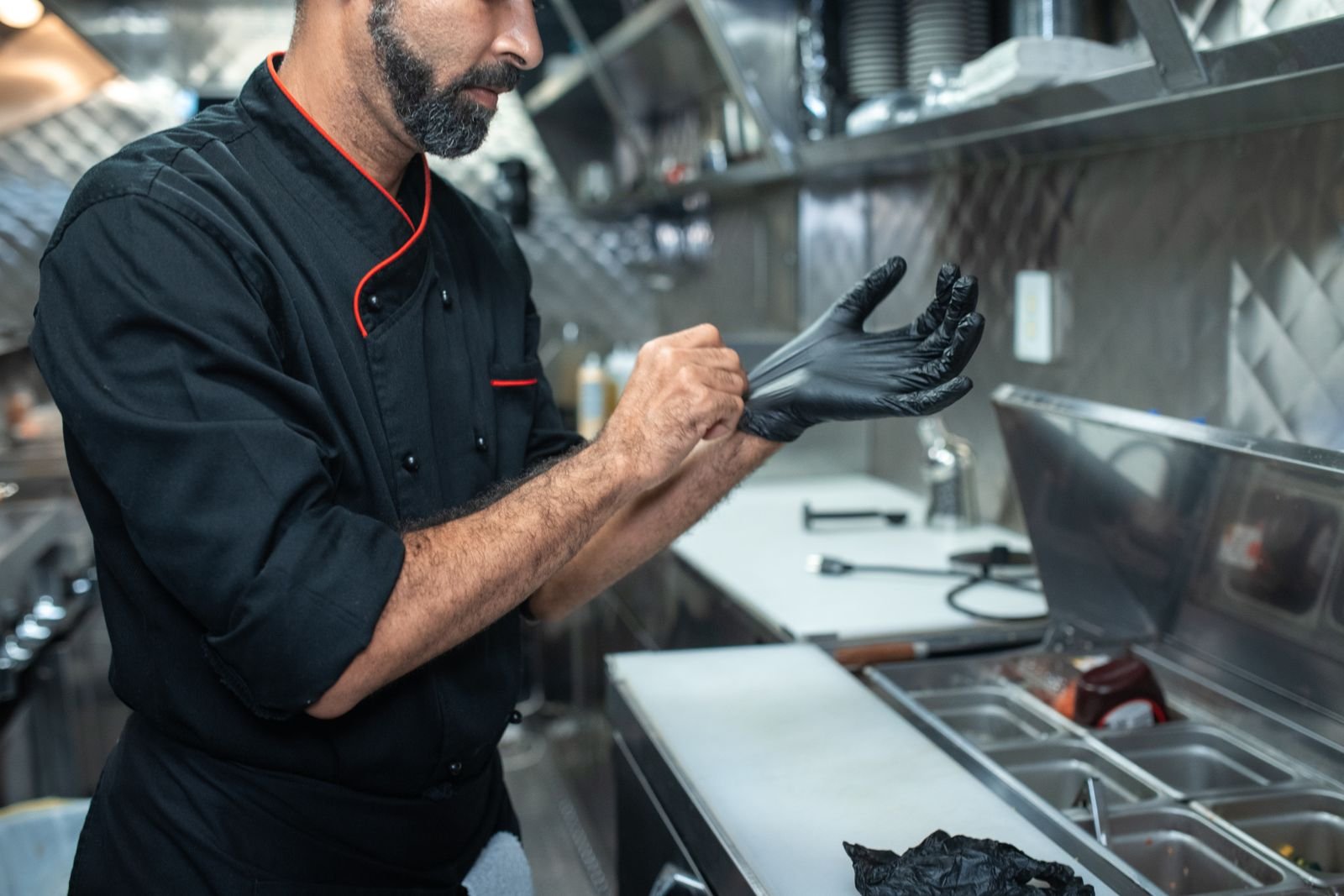
Food safety
For: Food service, Safety & facilities and 1 more role
Food safety
For: Managers & supervisors, Food service
Food safety
For: Teachers & school staff, Food service
Try removing a filter or searching for a broader term.
Clear all filtersSeveral states require food employees to hold a food handler card from a program accredited through ANSI or a state agency. California requires one within 30 days of hire, valid for three years; Texas within 30 days of employment, from a program accredited by the state health department or ANSI; and Illinois within 30 days of employment, renewed every three years.
Our food handler course is not one of those accredited programs, and it does not issue a state food handler card or a certified food protection manager credential. It teaches the same core practices for staff whose employer or jurisdiction does not require a card, for refresher training and for onboarding before a card exam. Check your state and local health department before you choose.
If your state or county requires an accredited food handler card, get that card through an accredited program. A certificate of completion from this site will not replace it.
Courses on this topic
The FDA Food Code is a model that states and local agencies adopt into their own rules; it is not federal law on its own. FDA publishes it on a four-year cycle and released the 2026 edition on September 30, 2026. Changes in the summary include:
States adopt editions at different times. FDA’s adoption report lists, for example, the 2009 edition in Michigan, 2013 in Massachusetts, 2017 in Virginia and 2022 in Illinois, so always follow the code your inspector enforces.
Courses on this topic
| Control | Limit (°F) |
|---|---|
| Cold holding | 41°F or below |
| Hot holding | 135°F or above |
| Cooling cooked food | 135°F to 70°F within 2 hours, then to 41°F or below within 4 more hours |
| Reheating for hot holding | 165°F within 2 hours |
| Cooking poultry and stuffed foods | 165°F |
| Ready-to-eat food held cold | Up to 7 days at 41°F, counting the day of preparation as day 1 |
| Handwashing | At least 20 seconds, with 10 to 15 seconds of vigorous scrubbing |
These are Food Code values as written into state rules such as Minnesota’s and Texas’s; your state’s code may differ. The Food Cooling Log Generator prints a log for the two-stage cooling check.
Courses on this topic
Federal law names nine major food allergens: milk, egg, fish, crustacean shellfish, tree nuts, wheat, peanuts, soybeans and sesame. Sesame became the ninth on January 1, 2023 under the FASTER Act. Packaged food labels must name the allergen in the ingredient list or in a “Contains” statement, including the specific type of tree nut, fish or shellfish.
Some states go further for restaurants:
Courses on this topic
Hazard Analysis and Critical Control Points is a way of finding the steps where a hazard must be controlled and proving it is. HACCP training is split by role: employees learn to monitor a critical control point, record it and act when a limit is missed; managers and team members learn to build and verify the plan itself, with worksheets for each of the seven principles.
Foodborne illness is common enough to justify the paperwork. The CDC estimates 48 million illnesses, 128,000 hospitalizations and 3,000 deaths from foodborne disease in the United States each year.
Courses on this topic
| You work | Course |
|---|---|
| In a restaurant, café, food truck or school kitchen | Food Handler Training |
| Front of house or as a chef or manager | Food Allergen Awareness |
| In a nursing home or assisted living kitchen | Food Safety in Long-Term Care |
| In production under a food safety plan | HACCP Essentials for Food Employees |
| As a QA lead writing the plan | HACCP Principles and Plan Development |
| On packaging and labels | FDA Food Labeling Requirements |
About credit
Every course earns a certificate of completion for its stated contact hours. A course is approved by a licensing board or accreditor only when the approval and its number are shown on the course page. Check with your board, employer or state agency whether a course meets your requirement. See our approvals list.
No. States that require a card, such as California, Texas and Illinois, require an accredited program, and our courses are not accredited for that purpose. You receive a certificate of completion, which some employers use for onboarding or refresher training.
They teach the 2026 FDA Food Code and point out where older editions still in use differ. Because each state adopts its own edition, always check the code your health department enforces.
Yes. Every course, log and job aid uses degrees Fahrenheit, the unit US food codes use.
Yes. The long-term care food safety course is written for both roles, and team seats let you assign it to each person and see completions in one place.
Preview the first module of any course free. Pay only when it is the right fit.