HIPAA Privacy and Security for Healthcare Workers
- Privacy and security basics in one course
- Useful for new hires before your policy session
- Dated certificate for your six-year log
By profession
Healthcare Compliance
HIPAA does not hand you a ready-made course or a fixed annual date. It tells covered entities and business associates to train their workforce on their own policies, at specific moments, and to keep proof for years. This guide shows exactly what the rule text requires and how to document it.
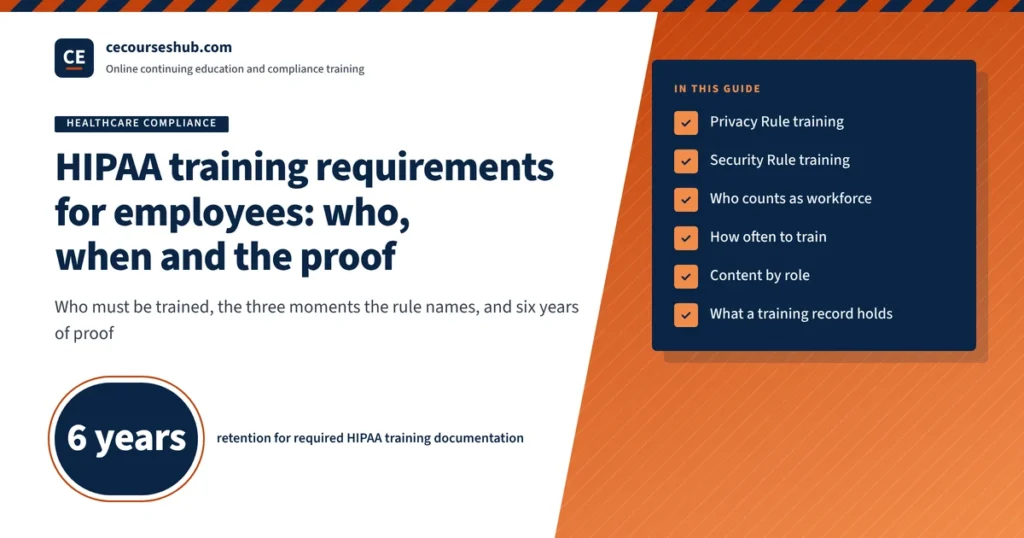
Two HIPAA rules require workforce training. The Privacy Rule, at 45 CFR 164.530(b), requires a covered entity to train all members of its workforce on its privacy policies and procedures as necessary and appropriate for their jobs, and to train new members within a reasonable period after they join and anyone affected by a material policy change within a reasonable period after it takes effect. The Security Rule, at 45 CFR 164.308(a)(5), requires covered entities and business associates to run a security awareness and training program for all workforce members, including management. Training must be documented, and the records kept for six years.
Most people meet HIPAA training as a slide deck on the first day of a new job and a refresher sometime later. Behind that routine sits a short set of legal duties that many employers only read closely after a complaint, a breach or an audit request. The duties are not complicated, but they are specific about who must be trained, when, on what, and what proof must exist afterwards.
This guide is for privacy officers, practice managers, HR teams at clinics and health plans, and the vendors who handle health data for them. It is also for frontline staff who want to know why the training is assigned. Every requirement below comes from the regulation text and guidance published by the Department of Health and Human Services (HHS). State privacy laws can add more, so check your own state as well.
The core duty is in 45 CFR 164.530(b)(1): a covered entity must train all members of its workforce on the policies and procedures with respect to protected health information (PHI) required by the Privacy Rule and the Breach Notification Rule, as necessary and appropriate for them to carry out their functions. Two things follow from that wording. First, the training is about your organization's own policies, not a generic summary of the law. Second, content can vary by role: what a billing clerk needs is not what a nurse or a receptionist needs.
The rule then names three moments when training must happen, in 164.530(b)(2)(i):
Every member of the workforce must be trained no later than the covered entity's compliance date. For established organizations this is the baseline every current worker should already have.
Each new member must be trained within a reasonable period of time after joining. The rule does not set a number of days, so write your own deadline into policy.
Anyone whose functions are affected by a material change in the privacy or breach policies must be trained within a reasonable period after the change takes effect.
Finally, 164.530(b)(2)(ii) requires the covered entity to document that the training was provided, as required by the documentation standard in 164.530(j). The HHS Summary of the HIPAA Privacy Rule describes the same duty in plain terms: train workforce members on privacy policies as necessary and appropriate for their roles, and apply sanctions against those who violate them.
The Security Rule covers electronic PHI and applies to both covered entities and business associates. Its training standard, 45 CFR 164.308(a)(5)(i), requires a security awareness and training program for all members of the workforce, including management. It lists four implementation specifications, all marked addressable.
| Point | Privacy Rule, 164.530(b) | Security Rule, 164.308(a)(5) |
|---|---|---|
| Who must train | Covered entities | Covered entities and business associates |
| Who is trained | All workforce members, as necessary and appropriate for their functions | All workforce members, including management |
| Content | The organization's policies and procedures on PHI, including breach notification policies | Security reminders, protection from malicious software, log-in monitoring, password management (all addressable) |
| Timing | Compliance date, new members within a reasonable period, and after material changes | An ongoing program; security reminders are described as periodic security updates |
| Proof | Document training under 164.530(j); keep 6 years | Document required actions under 164.316(b); keep 6 years |
"Addressable" does not mean optional. Under 45 CFR 164.306(d)(3), the organization must assess whether each specification is reasonable and appropriate in its environment. If it is, the organization implements it. If it is not, the organization documents why and implements an equivalent alternative measure if that is reasonable and appropriate. Size, complexity, technical capabilities, costs and the likelihood and severity of risks are the factors listed in 164.306(b). Phishing and password habits are where most workforce security training starts, and our cybersecurity awareness courses cover those topics for non-technical staff.
A proposed change is not a rule yet. In January 2025 HHS published a proposed rule to strengthen the Security Rule (90 FR 898), with comments due March 7, 2025. A proposal does not change what the current regulation requires. The current text of 164.308(a)(5) quoted above is what applies until a final rule is published and takes effect, so check the Federal Register before you change your program.
HIPAA defines workforce broadly in 45 CFR 160.103: employees, volunteers, trainees and other persons whose conduct, in the performance of work for a covered entity or business associate, is under its direct control, whether or not they are paid. That definition is why "only clinical staff" training plans fall short.
Business associates are not off the hook. The Security Rule's training standard applies to them directly, so a vendor that stores or processes electronic PHI needs its own security awareness program. If you are a vendor, expect clients to ask for proof. For a closer look, see our guide: Bloodborne pathogens training requirements.
The regulation does not say "annually." It ties Privacy Rule training to events: the compliance date, joining the workforce and material policy changes. Security training is an ongoing program with periodic security updates. Many organizations still choose an annual refresher because it is easy to schedule and audit, and because it catches policy changes that were never retrained. That is a policy choice you make and write down, not a federal deadline.
Write down three things in your policy: the number of days within which new hires must finish training, what you treat as a material change that triggers retraining, and whether you run a scheduled refresher. Then measure yourself against your own policy, because that is what an investigator will compare you to.
Because the Privacy Rule asks for training "as necessary and appropriate" for each person's functions, role-based content is both allowed and sensible. A practical split looks like this, always built on your own policies:
Sanctions belong in the training because the rules require them. 164.530(e) requires a covered entity to have and apply appropriate sanctions against workforce members who fail to comply with its privacy policies and to document the sanctions applied, and 164.308(a)(1)(ii)(C) requires a sanction policy for security violations. Breach reporting belongs there too: staff should know how to raise a concern internally the same day. For the rules that apply once a breach is confirmed, our data breach notification lookup helps you look up state breach notification rules.
HHS's Office for Civil Rights (OCR) enforces HIPAA, and when it settles an investigation it often requires a corrective action plan. Workforce training appears in those plans again and again.
In May 2025 OCR announced a settlement with a small California provider of MRI and imaging services. An unauthorized third party had accessed electronic PHI on its image storage server, affecting 21,778 individuals. OCR found the provider had never performed a HIPAA risk analysis and had not sent breach notifications within the required 60 days of discovery.
The provider paid $5,000 and agreed to a corrective action plan monitored for two years. Among its terms: written policies and procedures to comply with the HIPAA Rules, and workforce training on those HIPAA policies and procedures for all workforce members with access to electronic PHI. (Source: HHS press release, May 15, 2025, listed below.)
The pattern is worth noting. Training on its own did not cause or prevent that breach, but once OCR found gaps, policies and training were part of the fix. Building them before an investigation is cheaper and calmer than building them under monitoring.
164.530(b)(2)(ii) requires documentation that training was provided, and 164.530(j)(2) requires keeping required documentation for six years from the date of its creation or the date when it last was in effect, whichever is later. Security Rule documentation has the same six-year period under 164.316(b)(2)(i). A record that answers an auditor's questions usually includes:
| Field | Why it matters |
|---|---|
| Worker name and role | Shows training matched the person's functions |
| Date joined and date trained | Shows new hires were trained within your "reasonable period" |
| Training trigger | Initial, new hire, material change, or scheduled refresher |
| Topic and policy version | Links the training to the policies in effect at the time |
| Format and materials | Session slides, module title or course certificate |
| Completion evidence | Signed attestation, sign-in sheet, quiz result or certificate |
| Retention date | Six years from creation or last effective date, whichever is later |
Include employees, volunteers, trainees, managers and anyone else under your direct control, and note each person's role.
Write into policy how many days new hires have to complete training and what counts as a material change that triggers retraining.
Combine your own policies with a general HIPAA course, adding front desk, clinical and manager content where it fits.
Cover security reminders, malicious software, log-in monitoring and passwords, or document why an alternative measure is used.
Log who was trained, when, why, on which policy version, with proof of completion, and keep the records for six years.
If you manage training across several departments, the employer training planner helps you set dates and roles in one place. Long-term care employers can pair this with our guide to CNA in-service requirements, since nurse aides often need both. To see every healthcare course in one list, browse the healthcare and patient care catalog.
These courses give your workforce general HIPAA, privacy and security awareness content with a dated certificate for your training log. Add your own policies so the training reflects how your organization handles PHI.
Courses award a certificate of completion for the contact hours shown. Your organization decides whether a course fits its HIPAA training program. How CE credit works.
The regulation does not set an annual deadline. The Privacy Rule requires training for the existing workforce, for new members within a reasonable period after they join, and for staff affected by a material policy change. The Security Rule requires an ongoing security awareness program. Many organizations choose an annual refresher as a written policy.
All members of the workforce, which 45 CFR 160.103 defines as employees, volunteers, trainees and other persons whose work is under the direct control of the covered entity or business associate, whether or not they are paid. Security training expressly includes management.
Within a reasonable period of time after they join the workforce, under 45 CFR 164.530(b)(2)(i)(B). The rule does not give a number of days, so set your own deadline in policy and track it.
Six years from the date the record was created or the date it was last in effect, whichever is later, under 45 CFR 164.530(j)(2). Security Rule documentation has the same six-year period under 164.316(b)(2)(i).
Yes for security. The Security Rule standard at 45 CFR 164.308(a)(5) requires covered entities and business associates to run a security awareness and training program for all workforce members, including management.
An online course can deliver general content, but the Privacy Rule requires training on the organization's own policies and procedures. Most employers combine a general course with a session or document on their own policies, and they decide whether a course fits their program.
The Security Rule lists four addressable topics: security reminders, protection from malicious software, log-in monitoring and password management. Addressable means the organization assesses each one and implements it, or documents why not and uses an equivalent alternative if reasonable.
A proposal published in January 2025 does not change current requirements on its own. The current text of 45 CFR 164.308(a)(5) applies until a final rule is published and takes effect, so check the Federal Register for its status.
HIPAA training is not one annual video. It is training on your own policies, delivered to everyone in your workforce at three defined moments, backed by an ongoing security awareness program, with records you can produce for six years. Set written deadlines, tailor content by role, and keep the log. For staff, the training is how you learn what your organization expects before a mistake happens. A general course such as the HIPAA privacy and security course for healthcare workers is a sound starting point to pair with your policies.
CE Courses Hub Editorial Team. Checked against the official sources listed above on . Rules change: confirm the current text with the agency before you rely on it. Read our editorial and review policy.
General information for US workers and employers, not legal advice.
Assign HIPAA and security courses with team seats and keep every completion in one place for your six-year records.
Bloodborne pathogens training requirements under OSHA 1910.1030(g)(2): who needs it, the 14 required topics, annual timing, online rules and 3-year records.
Texas HB 300 training is due within 90 days of hire, not 60, and the 2-year cycle ended in 2013. Who must train, what to cover…
Dysphagia diets in nursing homes: the 8 IDDSI levels, who orders it, F805 and F808 survey tags, staff training and the tray error behind a $20,505…