Informed Consent, Capacity and Patient Rights
- The right to accept or refuse treatment, explained
- Capacity and decisions made by representatives
- A dated certificate for your staff education file
By profession
Healthcare Compliance
Every Medicare and Medicaid hospital, nursing home, home health agency and hospice must tell adult patients about their right to make an advance directive, record whether they have one, and train staff on its policies. Here is when the notice is due for each provider type, what it must say, and how to prove you did it.
The Patient Self-Determination Act (PSDA) amended section 1866 of the Social Security Act, where the duty now sits in section 1866(f), and CMS carries it out through 42 CFR 489.102. Hospitals, critical access hospitals, rural emergency hospitals, skilled nursing and nursing facilities, home health agencies, personal care providers, hospices and religious nonmedical institutions must keep written advance directive policies for all adults they serve. They must give written information about the patient's rights under state law and about their own policies at set times, document in a prominent part of the record whether the person has an advance directive, never condition care on it, follow state law, and provide education for staff and the community. The rule sets no hour count for staff education, so each provider decides how to deliver it and keeps proof.
Advance directive questions are part of almost every admission packet in the country, and that is exactly why they go wrong. When a question becomes routine, it gets asked quickly, ticked without a conversation, or skipped when the patient is too unwell to answer and never revisited. Surveyors see the results in charts where the advance directive box is blank, or where the patient's living will sits in a drawer at home with no note of it anywhere.
This guide is for admissions and intake staff, nurse managers, social workers, compliance officers and educators in hospitals, nursing homes, home health and hospice. It explains each duty in the regulation, the timing for each provider type, the content of the written notice, the incapacity rule, and what staff and community education should look like on paper.
The statute, at section 1866(f)(1) of the Social Security Act, requires providers to maintain written policies and procedures for all adult individuals receiving medical care by or through them. The regulation at 42 CFR 489.102(a) breaks those policies into six duties.
About the person's rights under state law to accept or refuse treatment and to formulate advance directives, and about your own policies for honoring those rights.
Document in a prominent part of the current medical record whether or not the individual has executed an advance directive.
Do not condition care or otherwise discriminate against a person based on whether they have an advance directive.
Comply with state law on advance directives, and tell people that complaints can go to the State survey and certification agency.
Provide education for staff on the provider's advance directive policies and procedures.
Provide community education on advance directive issues, alone or with others, and be able to document it.
An advance directive, for these rules, is a written instruction such as a living will or durable power of attorney for health care, recognized under state law, about the provision of health care when the individual is incapacitated (42 CFR 489.100). The PSDA does not create a federal advance directive form. It makes providers explain the rights that state law already gives.
Two limits protect providers too. Under 489.102(c), a provider is not required to provide care that conflicts with an advance directive, and it is not required to implement a directive on grounds of conscience if state law allows any health care provider or agent to object conscientiously.
Timing depends on the setting. The regulation sets the moment for each provider type in 489.102(b), and other parts of the CMS rules repeat the duty for specific settings.
| Provider | When to give the information | Rule |
|---|---|---|
| Hospital | At the time an individual is admitted as an inpatient | 489.102(b)(1); also patients' rights at 482.13(b)(3) |
| Skilled nursing facility | At the time of admission as a resident | 489.102(b)(2); nursing home residents' rights at 483.10(g)(12) |
| Home health agency | In advance of the individual coming under the agency's care; may be given at the first home visit if that is before care begins | 489.102(b)(3)(i) |
| Personal care services provider (Medicaid) | In advance of the individual coming under the provider's care, with the same first-visit allowance | 489.102(b)(3)(ii) |
| Hospice | At the time of initial receipt of hospice care | 489.102(b)(4); hospice patients' rights at 418.52(a)(2) |
| Rural emergency hospital | At the time of registration as a patient | 489.102(b)(5) |
| Medicare Advantage organization | At the time of initial enrollment | 42 CFR 422.128 |
For nursing homes, 483.10(g)(12) ties the resident's rights directly to Part 489 subpart I, and 483.10(c)(6) lists the resident's right to request, refuse or discontinue treatment and to formulate an advance directive. Hospice rules at 418.52(a)(2) require the hospice to follow the same subpart and give written material on its policies and on applicable state law. Medicaid providers carry the same duties through section 1902 of the Social Security Act, which OBRA '90 amended in section 4751.
The notice has two halves. One explains the person's rights under state law. The other explains how your organization will honor them.
The 90-day trap. Many organizations print their advance directive leaflet once and forget it. If your state legislature amends its health care decisions law, the clock starts when the change takes effect. Put a yearly review of state law changes on your compliance calendar, and keep the dated versions of your leaflet.
Section 489.102(a)(2) asks for the answer in a prominent part of the current medical record, whether or not the person has a directive. A blank field does not meet that test, and neither does a note buried in a scanned admission bundle. A clear entry might look like this.
Notice what the entry also shows: who received the information, when, and in what language, plus a follow-up when the document itself is not yet in hand. The regulation does not require the copy, but your staff cannot follow a directive nobody has seen. Train staff to ask whether the person has a document, where it is, and who the named agent is.
Never let the answer change the care offered. The no-conditioning duty in 489.102(a)(3) means a patient without a directive cannot be refused admission or steered to a different service, and staff should not pressure anyone to sign one as part of intake.
Patients often arrive confused, sedated or in crisis. Section 489.102(e) covers this case for adults who, because of their condition or a mental disorder, cannot receive the information or say whether they have a directive.
The provider may give the advance directive information to the person's family or surrogate, in the same way it issues other materials about its policies, and as state law allows.
The provider is not relieved of its duty to the individual. Note in the record why the person could not receive the information and who received it instead.
Give the information to the individual directly. The regulation requires follow-up procedures so this actually happens.
Close the loop in the chart: date, who explained it, and the person's answer about any directive.
Nursing homes have the same rule in 483.10(g)(12)(iv): if the resident was incapacitated at admission, the facility may give the information to the resident's representative, and must give it to the resident once the resident is able to receive it. A simple reminder in the care plan review is often enough to catch residents whose condition has improved.
Section 489.102(a)(5) says the provider must provide education for staff concerning its policies and procedures on advance directives. When CMS finalized the rule in 1995, it chose not to prescribe specific education methods, so the format is yours to choose. What matters is that the people who carry out the policy understand it and that you can show they were taught.
Give the written notice at the right moment, ask the questions, record the answer and flag follow-up when the patient cannot respond. For a closer look, see our guide: Dysphagia diets in nursing homes.
Check the record at handoff, find and file copies, and alert the care team when a directive affects the plan of care.
Help people who want to complete a directive, using the state's own forms and rules.
Know the provider's conscience statement, how to raise an individual objection, and how directives connect to consent and orders.
A short, consistent script helps new staff ask the questions the same way every time.
"This leaflet explains your right under state law to make decisions about your care, including the right to accept or refuse treatment and to write an advance directive. Having one is your choice, and your care here does not depend on it."
"Do you already have a living will or a health care power of attorney? Where is it kept, and who is the person you named?"
Nursing homes can fold this topic into the annual in-service plan for nurse aides; our guide to CNA in-service requirements under the federal 12-hour rule explains how that plan works, and the nurse aide in-service hours tracker helps you log the time.
Section 489.102(a)(6) is the duty that providers forget most easily. It requires community education on advance directive issues, either directly or with other providers and organizations. The regulation says the materials should define what an advance directive is, emphasize that it is designed to enhance an incapacitated individual's control over medical treatment, and describe applicable state law. Providers may vary the materials by setting, and they must be able to document their efforts.
Whatever you choose, keep the date, audience, material used and the organization you partnered with. "We did a talk at some point" is not documentation.
The most detailed public review is a Government Accountability Office report from August 1995, GAO/HEHS-95-135, titled Patient Self-Determination Act: Providers Offer Information on Advance Directives but Effectiveness Uncertain. GAO found that health care institutions generally appeared to comply with most PSDA requirements and that nearly all providers informed patients of their right to have an advance directive.
Documentation was the weak point. GAO cited a 1992 HHS Inspector General survey which found that performance in clearly and consistently documenting the existence of an advance directive in the chart needed improvement. The same survey found that all or almost all facilities had written policies and educated their staff, while about two-thirds had planned or provided community education.
Share of Americans who, according to surveys GAO cited in 1995, had documented their end-of-life choices or appointed a health care agent. A notice at admission is often the first time a patient hears about the option.
The pattern still fits what many compliance teams see in their own audits: policies and leaflets are in place, but chart entries and community education lag behind. Those are the two areas where a short audit pays off.
List each service you run, such as inpatient, skilled nursing, home health or hospice, and the moment the advance directive information is due for each under 42 CFR 489.102(b).
Check that the leaflet explains rights under current state law and your own policies, including any conscience statement, and date every version.
Make the advance directive status a required, prominent entry that shows who received the information, when, and the follow-up for patients who could not answer.
Train admissions staff, nurses, social workers and practitioners on your policy and keep a dated record of who completed it.
Hold or join at least one community activity on advance directives and keep the date, audience and material used.
For whole departments, our employer training accounts let you assign courses and download completions for your file.
| Question | Where to look | Rule |
|---|---|---|
| Is the written information current with state law? | Leaflet version date and state law change log | (a)(1)(i) |
| Does it include any conscience limits, clearly stated? | Policy and leaflet | (a)(1)(ii) |
| Do sampled charts show advance directive status prominently? | Ten recent admissions | (a)(2) |
| Does the notice say complaints can go to the state survey agency? | Leaflet and patient rights notice | (a)(4) |
| Can you show dated staff education records? | Training system or sign-in sheets | (a)(5) |
| Can you show community education this year? | Event log and materials | (a)(6) |
| Were incapacitated patients followed up? | Charts with a family or surrogate notice | (e) |
These online courses help staff understand patient rights, capacity and person-centered decisions, and each ends with a certificate of completion you can keep as evidence of staff education. Pair them with training on your own policy and state forms.
Courses award a certificate of completion for the contact hours shown. How CE credit works.
It is the part of the Omnibus Budget Reconciliation Act of 1990 that added advance directive requirements to Medicare and Medicaid. It applies to services furnished on or after December 1, 1991, and CMS carries it out through 42 CFR 489.100 to 489.104.
42 CFR 489.102 lists hospitals, critical access hospitals, rural emergency hospitals, skilled nursing facilities and nursing facilities, home health agencies, providers of home health care and, for Medicaid, personal care services, hospices and religious nonmedical health care institutions. Medicare Advantage organizations have matching duties under 42 CFR 422.128.
At the time an individual is admitted as an inpatient, under 42 CFR 489.102(b)(1). Rural emergency hospitals give it at registration as a patient.
No. Providers may not condition the provision of care or otherwise discriminate against a person based on whether they have executed an advance directive, under 42 CFR 489.102(a)(3).
Under 42 CFR 489.102(e), the provider may give the information to the person's family or surrogate as state law allows, but it must still give the information to the individual once they can receive it and must have follow-up procedures for this.
Yes. 42 CFR 489.102(a)(5) requires education for staff on the provider's advance directive policies and procedures. The rule does not set hours or a format, so keep dated records showing who was trained and on what.
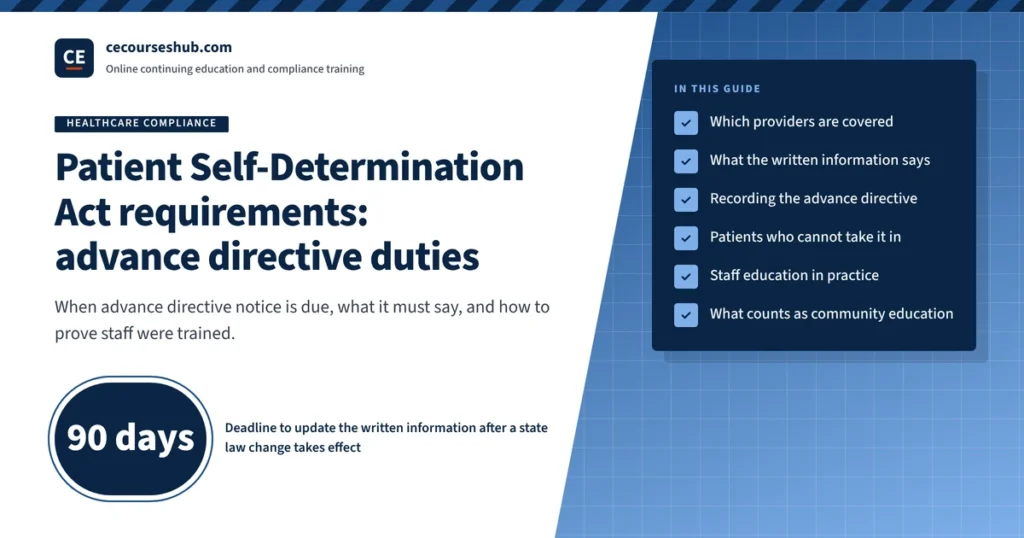
It must be updated promptly and no later than 90 days from the effective date of the change in state law, under 42 CFR 489.102(a)(1)(i).
Only if state law allows any health care provider or agent to object on grounds of conscience, and the provider must state the limitation clearly in its written information, including the difference between institution-wide and individual physician objections and the state legal authority.
Providers must tell individuals that complaints about the advance directive requirements may be filed with the State survey and certification agency, under 42 CFR 489.102(a)(4).
The PSDA asks providers to inform, record, respect, follow state law and educate, at the moment each person comes into care. Most organizations already have the leaflet. The gaps are usually the chart entry, the follow-up for patients who could not answer, and proof of staff and community education. Train the people who ask the questions, starting with the consent, capacity and patient rights course, and explore our wider healthcare course catalog for the rest of your plan.
CE Courses Hub Editorial Team. Checked against the statute, the regulations and the federal documents in the source list on . Advance directive law is largely state law, so confirm your state's current statute and forms before you update a leaflet. Read our editorial policy.
General information for US health care providers and their staff, not legal advice.
Assign patient rights training to every admissions team, nurse and social worker and keep all completions in one employer account.
Bloodborne pathogens training requirements under OSHA 1910.1030(g)(2): who needs it, the 14 required topics, annual timing, online rules and 3-year records.
Texas HB 300 training is due within 90 days of hire, not 60, and the 2-year cycle ended in 2013. Who must train, what to cover…
Dysphagia diets in nursing homes: the 8 IDDSI levels, who orders it, F805 and F808 survey tags, staff training and the tray error behind a $20,505…